Unique@CSE-AIML
Unique@CSE-AIML
The Future-Ready AI Engineer: Our Unmatched Edge in CSE (AIML)
Beyond a Degree — We Deliver Verified Skills and Global Credentials
Our Unique Value Proposition (UVP)
While other institutions teach theory, the CSE (Artificial Intelligence & Machine Learning) Department is the only program engineered for immediate professional deployment. We don't just award a B.Tech. We confer a portfolio of Industry Partnerships, State-Backed Skills, and Global Certifications that are essential for high-demand, high-salary roles worldwide. We are not just a college department.
Our Strategic Industry and Skill Development Partnerships
The Computer Science and Engineering (AIML) department is committed to providing an education that is deeply rooted in industry demands and cutting-edge technology. To ensure our students are immediately employable and future-ready, we have established crucial Memorandums of Understanding (MoUs) with leading organizations that enhance our infrastructure, faculty expertise and student skills.
Intel® Unnati Program: Building Data-Centric Excellence
Our partnership with the Intel® Unnati Program provides our department with an unparalleled advantage in high-performance computing and real-world AI deployment. Through this collaboration, we have established a dedicated Intel® Unnati Data-Centric Lab/Center of Excellence, offering students direct access to state-of-the-art Intel-based hardware, GPU clusters, and specialized software tools like the Open VINO™ toolkit. This infrastructure enables students to work hands-on with industrial-grade resources for training complex Deep Learning models and developing solutions in Edge Computing and IoT. Furthermore, students benefit from Intel-curated course modules and co-branded certifications, ensuring their technical knowledge is validated by a global technology leader, significantly boosting their resume and job prospects in the competitive AI market.
ICT Academy: Empowering Faculty and Professionalizing Students
enables students to work hands-on with industrial-grade resources for training complex Deep Learning models and developing solutions in Edge Computing and IoT. Furthermore, students benefit from Intel-curated course modules and co-branded certifications, ensuring their technical knowledge is validated by a global technology leader, significantly boosting their resume and job prospects in the competitive AI market.
TASK: Enhancing Employability through Government Support
Our collaboration with TASK (Telangana Academy for Skill and Knowledge), a prestigious initiative by the Telangana State Government, is central to maximizing the employability of our graduates. TASK provides a vital bridge between academia and industry by offering structured training in core soft skills, professional communication, and technical aptitude, alongside domain-specific technical skills delivered through its established industry partners. Crucially, TASK registration gives our students access to exclusive campus recruitment drives and job openings, providing a strong platform to launch their careers. Additionally, students benefit from access to the TASK e-learning portal for self-paced learning and the opportunity to pursue industry-certified courses often at discounted rates, equipping them with a complete skill set for immediate success in the technology sector.
Cisco Networking Academy (NetAcad)
We integrate the globally recognized NetAcad curriculum, providing students with essential skills in Cybersecurity, Networking, and IoT. This foundation is critical, as all AI/ML models must be securely deployed and operate within complex network infrastructures. Completion offers globally recognized Cisco certifications, enhancing expertise in the foundational layers of technology.
Global Certification Programs
Our commitment to producing job-ready engineers is demonstrated by the department's robust support for students pursuing high- value, global professional certifications. We recognize that deep specialization in AI/ML must be complemented by proficiency in the platforms where these intelligent solutions are deployed and integrated. Our students are actively engaged in structured training programs to achieve certifications in five critical areas, significantly enhancing their employability and market value:
Cloud Computing & DevOps (AWS)
Recognizing that AI workloads are fundamentally cloud-based, we prioritize training for AWS (Amazon Web Services) certifications (such as the Certified Cloud Practitioner). This ensures students are proficient in deploying, managing, and scaling the massive computational resources required for advanced AI/ML models in a cloud environment.
Intelligent Workflow Automation (ServiceNow & UiPath)
We prepare students for careers in enterprise automation by focusing on two leading platforms. Training for ServiceNow certifications allows students to integrate AI/ML capabilities (like Predictive Intelligence) into enterprise service management, while the UiPath program, including the Certified RPA Associate (UiRPA), equips them with skills to design and implement Robotic Process Automation (RPA) solutions. This dual focus positions our graduates at the forefront of digital transformation and operational efficiency.
Enterprise Applications & CRM (Salesforce)
Through training for certifications like the Salesforce Administrator/Developer (including the Salesforce Agent Blazer program),our students learn to integrate AI/ML models into the world's leading Customer Relationship Management (CRM) platform. This provides a unique and highly sought- after skill set for careers in Sales Technology, Marketing Automation, and personalized customer experience.
NoSQL Technologies (MongoDB)
Given that AI/ML relies on handling massive volumes of unstructured and rapidly changing data, our students receive training for MongoDB Developer and Administrator certifications. This mastery of NoSQL database technology ensures they can effectively model, store, and manage the flexible, large-scale datasets required by modern AI applications.
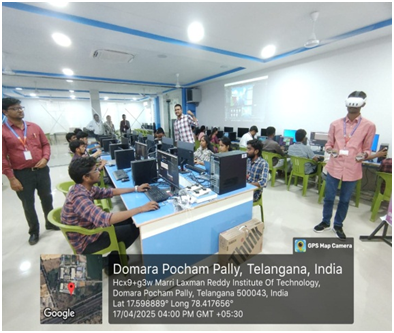
Cutting-Edge AR/VR Lab: Bridging Academia with Industry
Our college features a state-of-the-art Augmented Reality (AR) and Virtual Reality (VR) Lab, established through a strategic Industry Academic Alliance Program (IAAP) with industry leaders Fusion VR and ARK Infosolutions. This partnership transforms our learning environment into a professional Extended Reality (XR) development center. By integrating Fusion VR's expertise and leveraging ARK Infosolutions' role as a key technology provider, we ensure students train on industry- standard hardware and software, including the Unity 3D engine. This program delivers a job-ready curriculum, specialized faculty training, and a pathway to industry- recognized certification, directly preparing our students to create applications for Industry 4.0, the Metaverse, and the global XR market.
Laboratory Details
The Department of Computer Science and Engineering (AIML) is equipped with advanced and industry-aligned laboratories that provide students with hands-on experience, practical skill development, and exposure to real-time software and hardware environments. Each lab is designed to support project-based learning, experimentation, and research in core and emerging areas of computing and artificial intelligence.
🧠 Natural Language Processing (NLP) Lab
The Natural Language Processing Lab is dedicated to the study of human-computer interaction using natural languages. Students gain hands-on expertise in tokenization, parsing, sentiment analysis, machine translation, and text summarization using toolkits like NLTK and SpaCy. Projects focus on building conversational AI agents, language models, and systems that extract meaningful information from large volumes of text data.
🤖 Generative AI Lab
The Generative AI Lab focuses on the cutting edge of AI, training students to work with Generative Adversarial Networks (GANs), Variational Autoencoders (VAEs), and Large Language Models (LLMs). Students explore techniques for creating novel content, including synthetic image generation, deepfakes, realistic text creation, and music composition. This lab prepares innovators for roles in creative technology and advanced AI research.
📊 Soft Computing Lab
The Soft Computing Lab emphasizes computational techniques inspired by biological and natural systems, such as Fuzzy Logic, Genetic Algorithms, Swarm Optimization, and Neural Networks. Students learn how these techniques are applied in real-world optimization, classification, and prediction problems.
💡 Expert Systems Lab
The Expert Systems Lab provides training in developing knowledge-based systems and decision-support tools. Students learn about rule-based systems, inference engines, knowledge representation (ontologies), and reasoning under uncertainty. The focus is on creating intelligent systems that can mimic the decision-making ability of a human expert in specific domains, such as medical diagnostics, financial forecasting, or complex problem-solving.
📈 Machine Learning Lab
The Machine Learning Lab provides hands-on training in supervised and unsupervised learning algorithms, model training, evaluation, and data preprocessing using Python, Scikit-Learn, and real-world datasets. Students build ML models that solve real- time prediction and classification problems across various domains.
🔬 Deep Learning Lab
This specialized lab trains students in Deep Neural Networks, Convolutional Neural Networks (CNNs), RNNs, NLP models, and image/video processing using frameworks such as TensorFlow and PyTorch. Students work on cutting-edge applications such as image classification, face recognition, medical imaging, and speech processing.
☁️ DevOps Lab
The DevOps Lab focuses on automation, deployment pipelines, and system orchestration using Docker, Kubernetes, Jenkins, Git, and CI/CD workflows. Students learn how to deploy, monitor, and update AI/ML applications efficiently, preparing them for cloud and application delivery roles.
📱 Flutter Lab
The Flutter Lab offers intensive training in Google Flutter framework and the Dart language. Students learn to efficiently develop and deploy aesthetically pleasing, natively compiled applications for mobile (iOS/Android), web, and desktop from a single codebase. This hands-on experience prepares them for dynamic roles as cross-platform developers, meeting the industry demand for rapid and unified application delivery.
🗄️ MongoDB Lab
The Mongo Lab provides specialized training in modern Data Warehousing and NoSQL databases, with a practical focus on systems like MongoDB. Students delve into the management, scaling, and optimization of massive, unstructured datasets. This expertise is crucial for roles in Big Data architecture and backend development, enabling students to design and maintain the scalable data infrastructure required by contemporary web and AI services.
💬 Chatbot Lab
The Chatbot Lab focuses on the practical application of Conversational AI. Students learn the full pipeline of building intelligent agents, including Natural Language Processing (NLP) integration, intent recognition, dialogue flow management, and multi- platform deployment. Projects focus on creating functional virtual assistants for customer service, e-commerce, and information retrieval, preparing graduates for roles in intelligent automation and user experience design.